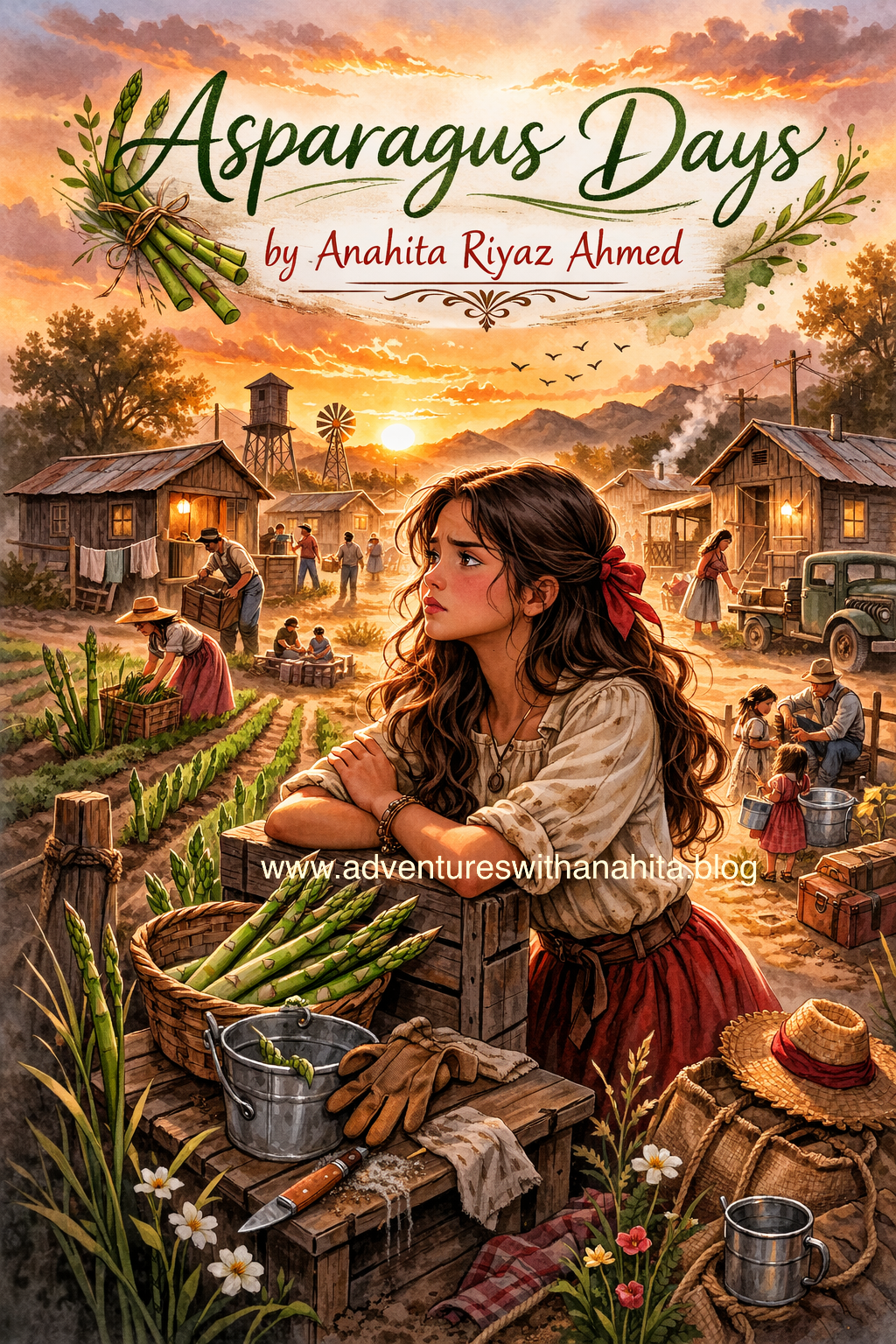
by Anahita Riyaz Ahmed
Clunk! I placed another clump of asparagus on the table after a long harvest. Isabel looked disgusted when she caught a glimpse of the plumose stalks, and I did not blame her.
We picked the spears from the fields, and a few days later new sprouts appeared. Then we picked them again — five or six times a week. This repetition created a nauseating feeling toward asparagus. Isabel talked of nothing else except wearing the winner’s crown of flowers atop her head.
“I hate asparagus,” Isabel said, barely looking up from her homework.
“During grapes, you hate grapes. During potatoes, you hate potatoes. And during asparagus, you hate asparagus,” I said teasingly. “I suppose during peaches you will hate peaches too.”
Isabel chuckled. “No, I love peaches.”
Hortensia stirred a pot of legumes while I took off the dirty apron I wore in the sheds and slipped on another. Then I began measuring flour to make tortillas. Soon, I was pounding the dough, my hands covered in white dust.
“My teacher will choose the Queen of the May this week,” Isabel said excitedly.
“Yes, you have told us,” I replied, twitting her. “Do you have something new to tell us?”
“They are making a new camp for people from Oklahoma,” Isabel said.
Hortensia nodded. “They announced it at the camp meeting. The owner of the farm bought some army barracks from an old military camp and is moving them onto the property not too far from here.”
“They get inside toilets, hot water, and a swimming pool!” Isabel added. “Our teacher told us we will be able to swim in it.”
“One day a week,” Hortensia said, glancing at me. “The Mexicans can only swim on Friday afternoons, before they clean the pool on Saturday mornings.”
I pounded the dough a little too hard. The flour burst out, covering the table and part of Isabel’s homework in white powder.
“Do they think we are dirtier than others?” I asked.
Hortensia did not reply. She heated the comal and placed the flattened dough onto the griddle. Then she signaled me with her finger to stay quiet while Isabel was near.
Just then, Miguel walked in from work. He kissed his mother’s cheek and reached for a tortilla and beans. His clothes were covered in mud that had dried into a grayish crust.
“How did you get so dirty?” Hortensia asked, eyeing his clothes like crawling insects.
“A group of men showed up from Oklahoma,” Miguel said, sitting down across from Isabel. “They said they would work for half the money, and the railroad hired them.”
He stared at his plate for a moment, then shook his head.
“Many of them have never worked on a motor before. My boss said he didn’t need me anymore. He said they were going to train the new men. He told me I could dig ditches or lay tracks if I wanted.”
I stared at him, my flour-covered hands frozen in the air.
“Can’t you tell from my clothes?” Miguel added. “I dug ditches.”
“Miguel, how could you agree to that?” I yelled.
“What would you have me do?” Miguel raised his voice. “If I walked out, I would not get paid. Those men have families too. We must all work, or we will starve.”
My anger boiled over.
“Why didn’t your boss tell them to dig ditches?” I shouted. “They had no experience anyway!”
I looked down at the dough in my hand and hurled it at the wall. It slapped against the surface and slid down, leaving a darkened trail.
Isabel’s eyes darted between Miguel, Hortensia, and me.
“Are we going to starve?” she asked nervously.
“No!” we all replied at once.
I ran out of the cabin, slamming the door behind me. I passed mulberry and chinaberry trees and ran through the vineyard, cutting between rows.
“Esperanza!” Miguel called.
I did not answer.
“Esper!”
I heard his footsteps growing closer. He caught my arm and turned me around.
“What is the matter with you, Esper?”
“Is this the better life you left Mexico for?” I cried. “Is it? Isabel will never be Queen of the May because she is Mexican. We work among people who still hate us. They send people back to Mexico if they speak up. We live in a tiny cabin while the Okies get hot water, toilets, and a pool. Why is this happening, Miguel? Are they royalty?”
Miguel looked toward the darkening sky.
“In Mexico, I was a second-class citizen,” he said quietly. “I would have stayed that way forever. Here, I have a chance to be more. You have always had hope — that is why you don’t understand.”
“Miguel,” I snapped, “you are still a second-class citizen because you act like one. That is why they take advantage of you.”
“You are beginning to sound like the strikers,” Miguel said coldly. “There is more than one way to succeed. Aguántate tantito y la fruta caerá en tu mano.”
Papa’s words struck me like stones. Wait a little and the fruit will fall into your hand.
But I was tired of waiting. I cried with my eyes closed, wishing that when I opened them I would be back in Mexico.
Miguel placed a hand on my shoulder.
“Esper, everything will work out.”
“How do you know?” I cried. “My life has been zigzag since we came here. Mama is ill. Abuelita is far away. Papa is gone. I see no proof of your optimism.”
“As bad as things are, we must keep persevering,” he said.
“But it doesn’t help,” I replied bitterly. “You are still on the other side.”
Miguel turned away and said quietly, “And you still think you are a queen.”