by Anahita
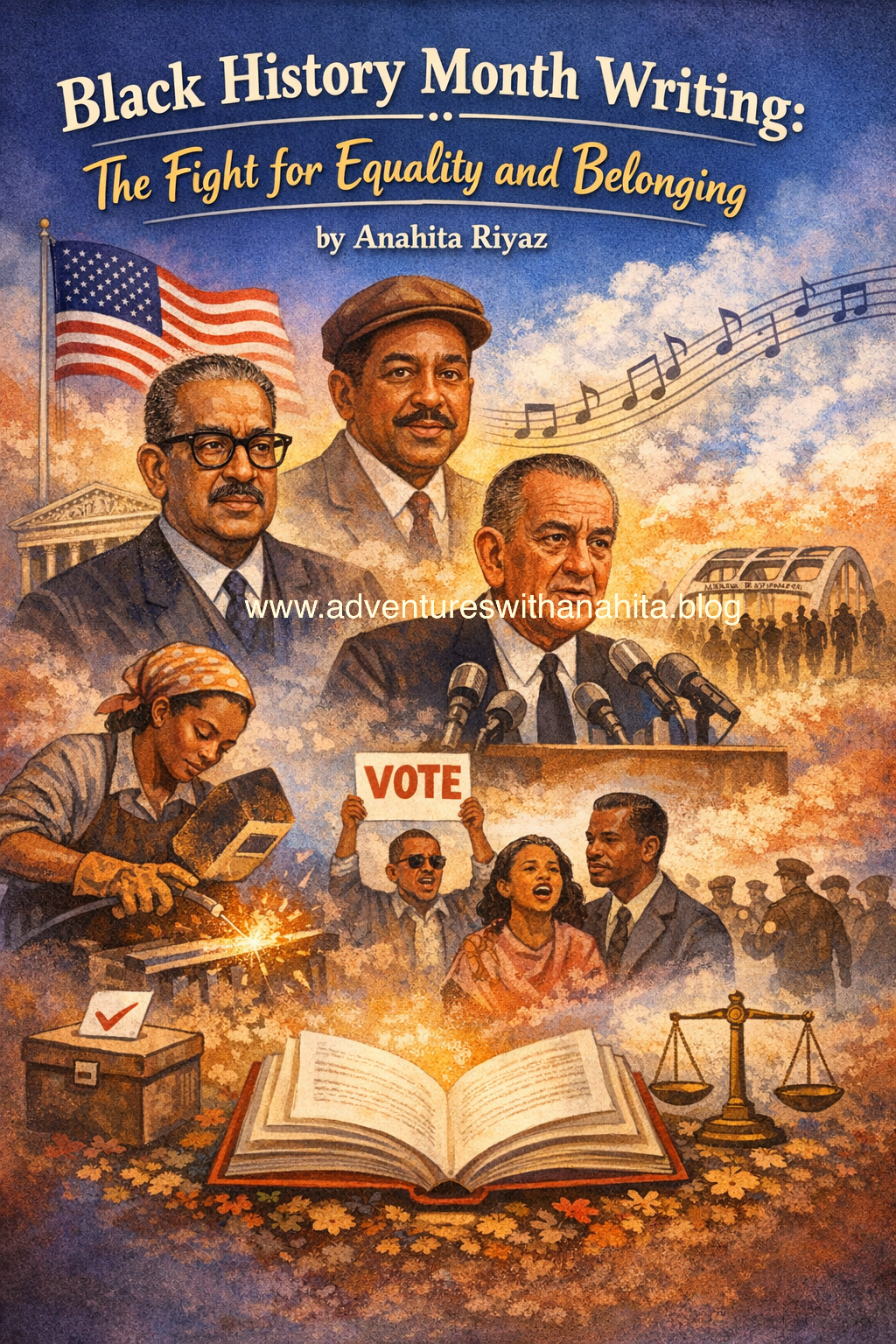
Black History Month is a time when the courageous acts of African Americans are honored, because they helped Black Americans gain rights and liberty. Walt Whitman, Langston Hughes, President Lyndon Johnson, and Thurgood Marshall all believed that freedom should be for everyone, not just one race or religion, because everyone is human — the same as you and me. This idea is veracious, meaning it is true — we all deserve to be on Earth no matter who we are.
Walt Whitman and Langston Hughes use the idea of “singing” to show belonging in America by explaining that everyone plays a role in our nation.
According to “I Hear America Singing,” “Each singing what belongs to him or her and none else.” Whitman is conveying that everyone does their part in America, even the women who clean and cook at home. The people Walt Whitman includes in his poem are workers and women — young wives and girls doing chores — all singing America’s melodious song. They are important to his message because they are part of America, working hard for themselves and others.
Based on “I, Too,” “I, too, am America.” Hughes is informing us that although he may be the “darker brother,” he still should be heard and treated equally, because he is also American. Langston Hughes shows hope for equality in his poem by telling us about his hardships and what he hopes the future will be like. In the end, both Walt Whitman and Langston Hughes show that everyone in America, no matter your race or whether you have a job, is still part of our nation — and that is what makes it whole.
This idea of equality and belonging is also reflected in American history. President Johnson believed that voting rights were an “American problem,” not just a problem for African Americans, because Americans needed to stop disenfranchisement and insults toward African Americans based on race. In “President Lyndon Johnson’s Voting Rights Act Address,” he states, “Those words are to every citizen that he shall share in the dignity of man.” President Johnson believed that it did not matter what your race or background was — everyone should be treated equally. That is why he called it an “American problem.”
President Johnson believed that African Americans should also be able to choose their leaders. He thought this because African Americans were living under leaders they did not get to vote for. President Johnson compared the events in Selma to Lexington, Concord, and Appomattox to show how it was a turning point in history, just like those earlier events. As mentioned in his address, “At times history and fate meet at a single time in a single place to shape a turning point in man’s unending search for freedom.”
This shows that President Johnson believed Selma was a turning point. A tragic event known as Bloody Sunday took place there, where peaceful protesters were attacked. Many were injured. These events helped bring change and showed that African Americans’ voices mattered and deserved to be heard.
The fight for equality continued even years later. Thurgood Marshall tells the audience that discrimination and prejudice are not the solution — freedom and equality are. He explains that division and unfair treatment lead to unrest, showing that the fight for freedom is ongoing.
At the time, racism still existed, but it was also connected to wealth and background. Marshall proved that racism was not the solution to the nation’s issues; equality and true freedom were. In 1992, people were divided not only by race, but also by wealth and education.
Thurgood Marshall said he once felt “optimistic” about America’s progress toward unity, but over time that hope faded. When he said, “We must dissent from a nation that has buried its head in the sand,” he meant that discrimination and division needed to be addressed, not ignored. Marshall wanted people to embrace diversity and stop apathy instead of pretending problems would disappear.
When Marshall said, “We will never rest until we are truly free,” he meant that people will continue fighting until they achieve true liberty and justice.
In conclusion, Thurgood Marshall, Walt Whitman, President Lyndon Johnson, and Langston Hughes all believed that everyone deserves freedom and dignity. They stood against Americans who denied liberty to African Americans because of race or religion. Their messages remind us that equality and belonging are what make America stronger.